Wednesday, April 9, 2014


Tuesday, April 8, 2014
Fun with English: okay this is just about my grammatical pet peeves...
I stole this shamelessly from Mary Rosenblum's newsletter to repost here because she's spot on and I can't improve on it. If you are an Indie Author and you aren't following Mary you should be.
If you haven't seen it yet this is the cover for my anthology due out early May.

If you haven't seen it yet this is the cover for my anthology due out early May.
The Craft Corner
Comma Splices
Grammar matters.
Yes, sorry about that, it does. If you submit to a commercial publisher, the editor does not expect to have to fix writing basics. That is your job as a professional! If you publish your own work, reviewers can be harsh about pointing out poor grammar and reviewing a book as a poor read. Now grammar is not so important in dialogue, although punctuation and that sort of 'nuts and bolts' level of grammar is still important. If your kid character, who grew up on the street in an urban slum, talks like a college graduate your characterization fails. Obviously!
But if it's the author's voice or narrative, it matters. Why?
It matters because a lot of your readers know their grammar and those mistakes will annoy them. Annoyed readers are not engaged readers. Many of your readers who do not know their grammar will know that the sentence sounds wrong, even if they can't tell you why it's wrong. That sense of 'wrong' will distract them from the story. Distracted readers are not engaged readers!
A comma splice is one of the most common style errors I see in novice author prose. What is a comma splice?
It's when you join two phrases that could be stand alone sentences, using a comma.
Cara ran through the trees, she was out of breath.
We have two sentences here: Cara ran through the trees. She was out of breath.
In English it is the job of a conjunction to join these two independent clauses, which is what you have when that clause could be a sentence on its own. That means we need something like 'and'.
Cara ran through the tree, and she was out of breath.
or…
Cara ran through the trees, even though she was out of breath.
We still have the comma, but now, combined with the conjunction, it is doing its job properly. Your grammar-knowledgeable readers will read happily on and your hind-brain grammar readers will stay engaged.
Remember…if the clauses on either side of that comma could each be a sentence on its own, you need a conjunction and comma to join them, not just a comma!
If one of the sentences is not an independent clause, if it is not a grammatically complete sentence on its own, then a comma alone is sufficient:
Cara ran through the trees, panting hard.
We do not have two complete sentences. Cara ran through the trees. Panting hard. Clearly, the first is a complete sentence, but the second is not. It's actually an adverbial phrase describing how she ran, just for those of you who want a bit more grammar education here.
Since we do not have two complete sentences to join, you simply use the comma, no conjunction is required.
Sunday, April 6, 2014
5 Charts for Indie Authors
Found for us by Amber Cook.
From Jane Friedman:
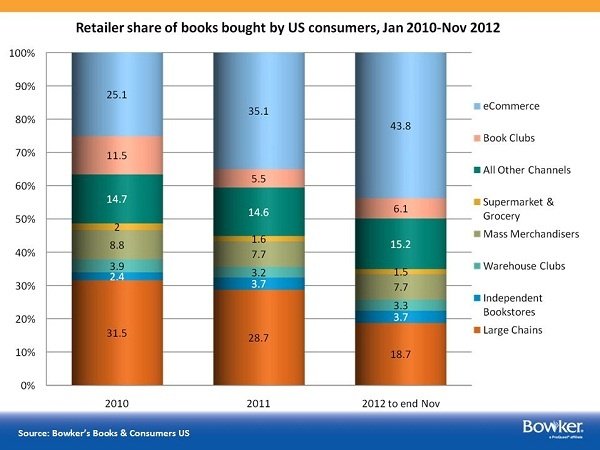
Source: Bowker’s Books & Consumers US; find out more about this report at Digital Book World. If anyone has seen 2013 figures, please let me know in the comments.
Key takeaway: By the end of 2012, nearly half of US book sales (print + ebook) were happening online (eCommerce), which is primarily driven by Amazon. Notice how the large chain bookstore retail share drops from 31.5% to 18.7%, driven in part by the bankruptcy of Borders. While many people focus on the percentage of ebook sales (currently averaging about 30%), I’d argue it’s more important to keep tabs on where the majority of sales are happening, regardless of format. This directly affects the value proposition of traditional publishers (at least for now) and how books get discovered and/or purchased—increasingly online through tech giants such as Amazon, Google, Apple, etc.
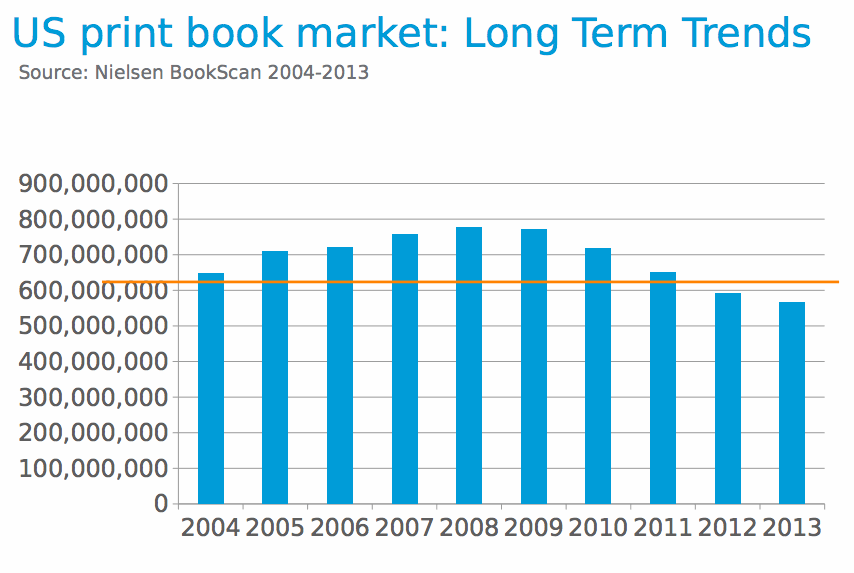
Source: Nielsen Bookscan, 2004–2013, reported on by Publishers Marketplace (subscription required).
Key takeaway: This chart shows print sales (in units) in the US print book market, which peaked in 2008-2009. In a 2014 presentation, Nielsen discussed how nonfiction adult sales peaked earlier, in 2007—but that children’s book sales are still ahead of their 2007 levels and comprise a larger part of the print market, meaning physical stores are important to that market (more so than adult books), and/or haven’t as successfully transitioned to digital.
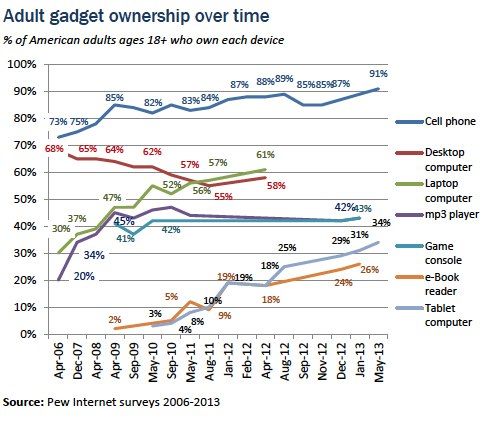
Source: Pew Internet Surveys, 2006–2013
Key takeaway: Mobile- and tablet-based reading environments already play—and will continue to play—an increasingly important role in how people discover, purchase, and consume content. Also notice that ebook readers are the least popular “gadget” on this chart; many people disagree on whether this will remain stable or decline. (Some say avid readers will always prefer a dedicated device; my personal opinion is that most reading behavior will shift to tablets or phones). Whether you have a website, e-mail newsletter, book, magazine—anything—to be successful for the longterm, you must consider the growing percentage of mobile- and tablet-based users. (Obviously, this is a much bigger trend affecting every business and organization.)
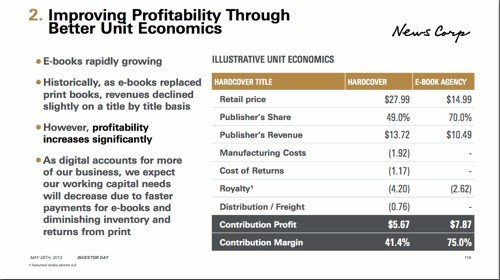
Source: HarperCollins presentation to News Corp.; reproduced at Publishers Marketplace
Key takeaway: E-books are significantly more profitable for publishers than print books, primarily because Big Five ebook royalties remain at 25%. Publishers Marketplace comments, “On a hardcover, the author earns 30% of the publisher’s gross revenue, and 42.5% of the total margin (what the author and publisher together earn). For now, on the ebook, the author earns 25%.” Read more (subscription required). The big question, of course, is how long can publishers keep the royalty rate at 25%? Hugh Howey has been asking this question, very publicly, over at AuthorEarnings.com.

Key takeaway: There is an unsurprising link between good metadata and sales. This particular report shows how complete metadata gives a sales boost to all book categories, but especially fiction, probably because fiction titles benefit from additional contextualization to aid searches. (If you’re looking for a nonfiction book on rose gardening, you can probably find it based on title and category; if you enjoy novels that take place in Europe in the 19th century, you’ll have a harder time unless that context is included in the metadata.) At BEA 2013, I listened to a panel on metadata, and the most memorable quote was from Phil Madans of Hachette: “If you don’t want your books to be found ever, use the Fiction: General category as your BISAC code.” For authors, this means: Don’t ever publish and distribute a book categorized as “general fiction.”

Friday, April 4, 2014


Wednesday, April 2, 2014
Fun with Alliteration
I stole this from Quora.com http://www.quora.com/
Marcus Geduld, Published author, lifelong reader.
Andrew asked Annabel about Alcoholic's Anonymous. But because babes buy bubbly beverages, Bel bickered. Can't couples communicate? Duh! Drunk dumb-dumbs debate. Everyone enjoys elocution. Flibbertigibbets flatter fellas; fellas fraternize. God, gabbers get grating! However, handsome hombres have healthy habits. I include Ignatz. Jesus! Jennifer justifies jealous jeering. Kindness keeps kin kinda kinky. Luckily, lovers likely love licking luscious legs. Meanwhile, Marcus marvelously mangles meaning. No! Neither nuance nor novelty negates negativity. Only Ontology, Orientalism, or Orthography obviates overdoing Occultism. Perhaps purple prose permeates popular periodicals. Quite! Quit quibbling! Quixotically queer queens quip quietly. Right? Radical reactionaries really resent redundancies. Really, really, really! So, stay silently stealthy. The timidity towards Teutonic tonic turns technically terrific talk to tittle-tattle. Understand? Unlikely. Unless users utilize unusual unicode. Very vexing! Well, we will wait without worrying, won't we? What words will we write? "Xu"? "Xi"? "Xis"? "Xyst?" Yes! You yammering yokels yack, yack, yack. Yawn! Zzzzzzzzzzzzzzzz ..
Andrew asked Annabel about Alcoholic's Anonymous. But because babes buy bubbly beverages, Bel bickered. Can't couples communicate? Duh! Drunk dumb-dumbs debate. Everyone enjoys elocution. Flibbertigibbets flatter fellas; fellas fraternize. God, gabbers get grating! However, handsome hombres have healthy habits. I include Ignatz. Jesus! Jennifer justifies jealous jeering. Kindness keeps kin kinda kinky. Luckily, lovers likely love licking luscious legs. Meanwhile, Marcus marvelously mangles meaning. No! Neither nuance nor novelty negates negativity. Only Ontology, Orientalism, or Orthography obviates overdoing Occultism. Perhaps purple prose permeates popular periodicals. Quite! Quit quibbling! Quixotically queer queens quip quietly. Right? Radical reactionaries really resent redundancies. Really, really, really! So, stay silently stealthy. The timidity towards Teutonic tonic turns technically terrific talk to tittle-tattle. Understand? Unlikely. Unless users utilize unusual unicode. Very vexing! Well, we will wait without worrying, won't we? What words will we write? "Xu"? "Xi"? "Xis"? "Xyst?" Yes! You yammering yokels yack, yack, yack. Yawn! Zzzzzzzzzzzzzzzz ..
Fun with English part 2
I found another fun fact in English. Well this is a little more technical, but if you are an English nerd like me this is cool. If you are anyone else maybe not. http://www.quora.com/
Tuesday, April 1, 2014
Where the most healthy people in the US Live--plus bonus tip
Okay this one I'm posting because I dig the bonus tip. Original Post
- According to a recent Gallup poll, adults in Vermont are the most frequent exercisers, which 65 percent of responders saying they get at least 30 minutes’ worth of exercise three times per week
- Delaware, West Virginia, Alabama, and New Jersey have the highest rates of couch potatoes. Here, only about 46-47 percent of adults get at least 1.5 hours of exercise each week
- Exercise can help prevent obesity, diabetes, and strokes, just to name a few. It also helps reduce stress and lowering your blood pressure
- BONUS TIP:
- According to a recent Flu Survey, exercising vigorously for at least two and a half hours each week could prevent 100 cases of flu per 1,000 people each year
Vigorous Exercise Is Excellent Preventive Medicine Against Cold and Flu
When you exercise, you increase your circulation and your blood flow throughout your body. The components of your immune system are also better circulated, which means your immune system has a better chance of finding an illness before it spreads. This includes (but is certainly not limited to) seasonal colds and influenza.According to a recent Flu Survey5 by the London School of Hygiene and Tropical Medicine, exercising vigorously for at least two and a half hours each week can reduce your chances of catching the flu.6 The survey suggests that 100 cases of flu per 1,000 people could be prevented each year this way.Other studies have also shown that regular exercise will help prevent the common cold. In one such study,7 women who exercised regularly were found to have half the risk of colds of those who didn't work out. And the ability of moderate exercise to ward off colds seemed to grow the longer it was used. The enhanced immunity was strongest in the final quarter of the year-long exercise program, suggesting that it is important to stick with exercise long term to get the full effects.
Subscribe to:
Posts (Atom)

 Posts
Posts


